
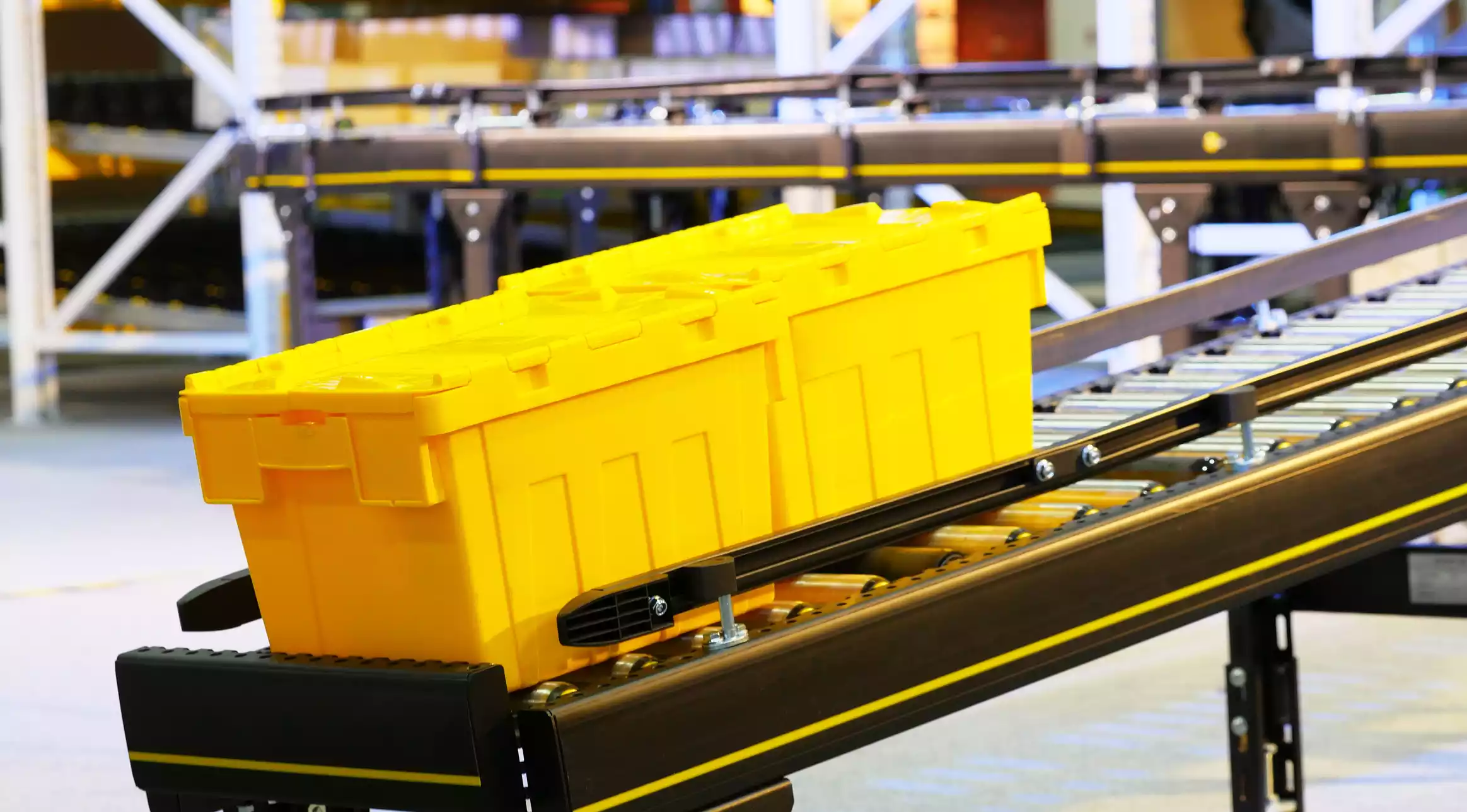
Modern distribution centers are under constant pressure to move more product, process more orders, and meet tighter delivery windows, all without proportionally increasing labor costs. For facilities relying on manual handling or rigid conveyor layouts, that pressure quickly exposes inefficiencies.
Scalable tote handling equipment offers a practical path forward. By designing systems that grow with throughput demands and adapt to changing workflows, distribution centers can improve accuracy, increase speed, and protect long-term capital investment.
Why Tote Handling Matters
Totes are the backbone of many fulfillment and light manufacturing environments. Whether moving small components, packaged goods, or work-in-process materials, totes create standardized units that simplify sorting, tracking, and storage.
However, as order volume increases, manual tote movement creates bottlenecks. Operators spend time walking product between zones. Sorting errors increase. Transfer points slow down. Over time, these friction points compound into measurable throughput loss.
Purpose-built tote handling systems such as conveyor networks, sortation, lift modules, and automated routing controls reduce that friction while maintaining flexibility.
The Advantage of Scalability
One of the most common mistakes in distribution center design is building for current volume rather than projected growth. A system that works at 60% capacity today may struggle when seasonal spikes or new customers push volume higher.
Scalable tote handling equipment addresses this challenge in several ways:
- Modular Conveyor Sections
Additional zones can be added without redesigning the entire layout. - Expandable Sortation Logic
Control systems can accommodate new lanes, destinations, or workflows without complete reprogramming. - Flexible Accumulation and Buffering
Dynamic accumulation allows facilities to absorb fluctuations without stopping upstream processes.
By prioritizing modularity, facilities avoid disruptive overhauls when growth occurs.
Improving Accuracy and Throughput
Automation in tote handling reduces reliance on manual decision-making. Integrated controls coordinate routing, merging, diverting, and buffering with precision.
Modern systems can integrate with warehouse management software to provide real-time visibility into tote location and order status. This level of coordination reduces misroutes, short ships, and rework.
High-volume fulfillment operations, such as those pioneered by ecommerce companies, demonstrate how tightly integrated tote handling and automation dramatically increase picking efficiency and order accuracy. While not every distribution center requires that scale, the underlying principle remains the same: eliminate unnecessary motion and automate repeatable transport tasks.
Supporting Labor Efficiency
Labor remains one of the largest operational expenses in distribution environments. When employees spend time pushing carts or transporting totes between zones, that time is not spent on value-added tasks like picking, quality checks, or packing.
Scalable tote handling equipment reduces nonproductive travel and positions operators closer to the work that requires human judgment. This approach not only increases output per labor hour but also reduces fatigue and ergonomic risk.
Designing for Long-Term Flexibility
Distribution environments rarely stay static. SKU counts change. Order profiles shift. Customer expectations evolve. Equipment must accommodate that evolution.
A well-designed tote handling system accounts for:
- Future lane expansion
- Additional mezzanine levels
- Increased sort destinations
- Integration with robotics or automated storage systems
Rather than locking a facility into a fixed footprint, scalable architecture protects future adaptability.
A Strategic Investment in Operational Control
Optimizing tote handling is not simply about adding conveyors. It requires thoughtful system design, proper controls integration, and a clear understanding of material flow dynamics.
For distribution centers seeking measurable gains in throughput, accuracy, and labor efficiency, scalable tote handling equipment provides a structured, future-ready solution. With the right automation partner, facilities can build systems that perform today while remaining ready for tomorrow’s demand.
UMD Automated Systems designs and integrates scalable material handling solutions that align with operational goals and growth projections. Whether upgrading an existing line or building from the ground up, a properly engineered tote handling system can transform distribution center performance. Contact us today to learn more.